


The white-washed walls of our village reflect the sun with dazzling brilliance, but the villa next door seems unaffected.
They moved in during the dark of the moon. The sort of neighbours one dreams of: quiet, wealthy, and unfailingly polite when spoken to. They call themselves traders from the north, yet I’ve never seen a single amphora of oil or crate of grain cross their threshold. What I have seen is the daughter, Xanthe, through the window.
She is a slip of a girl, pale as goat’s curd, always hovering within the recesses of their atrium. She never joins the other maidens at the well. She never feels the kiss of Apollo’s chariot on her skin.
Walking back from the market, I saw the parchment tacked to the communal fountain. It wasn’t the usual call for a lost sheep or a runaway slave. It was a plea from a grove-warden three villages over.
MISSING: A HAMADRYAD OF THE GIANT OAK.
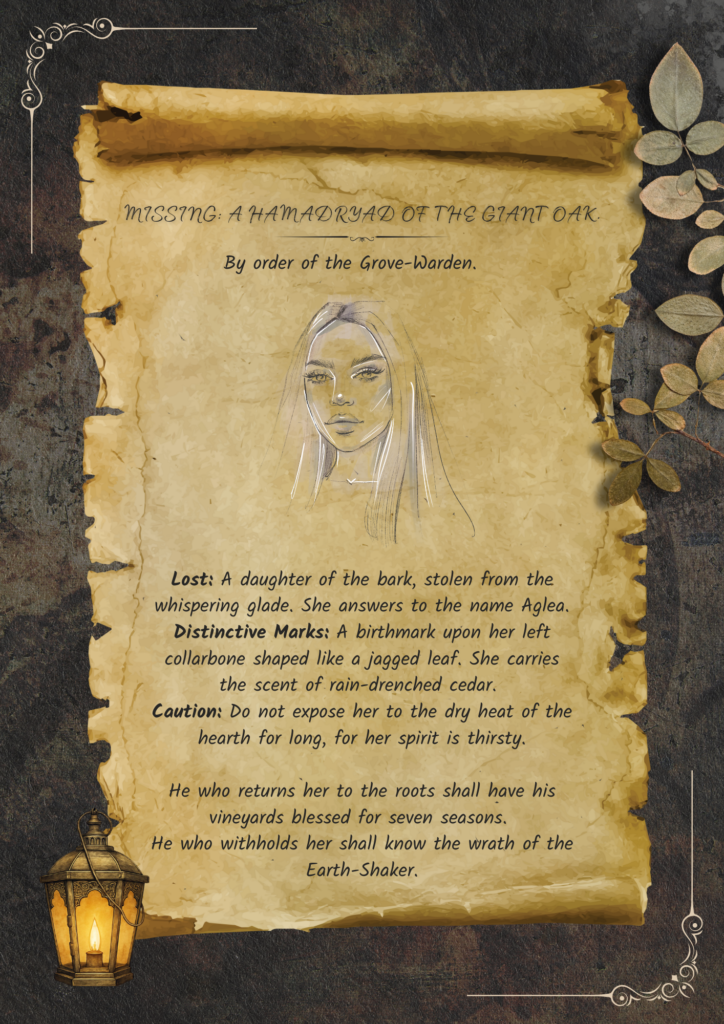
The sketch was crude, but the eyes were unmistakable. Large, amber, and filled with a terrifying stillness. They were Xanthe’s eyes. But dryads don’t live in stone houses. They don’t wear linen chitons. And they certainly don’t survive long once their bark is stripped away.
I looked back at the silent villa. A single leaf, vibrant green and dripping with a sap of citrus and honey, lay on the scorched earth of their doorstep.
My heart beat upon my chest. In this land, the gods are petty, and the monsters are often our own kin. I wondered —if I knocked on that door, would I be rescuing a girl, or interrupting a feast?
The villa’s door didn’t creak; it sighed, as if the wood itself was exhausted.
I didn’t knock. I didn’t have to. The heavy timber creaked inward, exposing a vestibule that gave off a fragrance not of the sea or roasted kid, but of moist soil and crushed hemlock. There was Xanthe. She wasn’t at the loom or the hearth. She was standing, looking over her shoulder at trees beyond the window… in a basin of dark, rich soil, her feet bare and seemingly fused to the marble floor.
“Xanthe?” I spoke softly, the name feeling like grit in my mouth.
“Aglea,” she gently corrected me, turning. Her amber eyes didn’t blink. Up close, her skin wasn’t only pale; it creased like aged parchment exposed too long to the rain. Under the fine linen chiton, her limbs shifted with an unnatural stiffness.
“They’re helping me,” she said, sounding like the wind sighing through autumn leaves. “The traders promised I could stay.”
The “father” emerged from the inner courtyard. He was too tall, his proportions wrong for a man who hauled grain. He smiled, showing teeth of sharpened flint.
“The Giant Oak was felled for a trireme,” he said, his tone deceptively mild. “We are merely… preserving the specimen. A dryad without a tree is a tragedy. A dryad in a jar, however, is an investment.”
I looked at the vibrant green leaf on the doorstep and then back at Aglea. She wasn’t being fed; she was being drained. The “citrus and honey” scent was her lifeblood, tapped like a resin to be sold to men who wanted to taste the divine.
My hand went to the small bronze knife at my belt. In our myths, the hero always finds a way. But as the “mother” stepped out from the kitchen, her fingers long and ending with thorns, I realised that in this village, some roots are better left buried.
The mother moved first. She didn’t run; she unfurled. Her fingers, long and needle-thin, lashed out like briars. I felt the sharp sting of a thorn across my cheek, the heat of blood spreading against the cool air of the atrium.
“She is ours,” the man snarled. No longer pretending. His words, the sound of a saw against green wood. “We bought the rights to the stump. We bought the soul within.”
I didn’t argue. In the market, you learn that some debts are paid in coin, others in pain. I lunged, not for the man, but for the alabaster jar sitting on the pedestal behind Aglea. Filled with the same honey-thick sap I’d seen on the doorstep, it presented… opportunities.
“Catch!” I yelled.
I didn’t throw it to the girl. I threw it at the charcoal brazier smouldering in the corner.
The explosion was silent but blinding—a burst of amber flame smelling of a forest fire in midsummer. The traders shrieked, like grinding stones, as the precious resin turned to a choking, golden smoke. In the confusion, I grabbed Aglea’s hand. Her skin was freezing, hard as heartwood.
“Run!” I commanded.
“I have no roots,” she wheezed, her amber eyes open with a terrifying vacancy.
“Then be a thistle,” I snapped, hauling her to the blinding brilliance of the village street.
I ran past the fountain and deep into the scorched hills. My lungs stung, dragging Aglea; her pace was heavy, movements erratic. Behind us, the villa remained silent, but I knew the traders wouldn’t stay away for long.
They had invested too much in her blood.
We reached the veiled spring—a place where the water still carried the earth’s deep secrets. Kneeling, I began to dig. My fingernails tore, dirt lodging under the cuticles, until I reached the cool, damp silt.
“Plunge your feet in,” I told her. “Claim this soil before they claim you.”
Once she stepped into the mud, her transformation was swift. The linen chiton didn’t tear; it merged. Her legs thickened, turning to grey-brown bark, and her hands lengthened into elegant, leafy reaches. She was a girl no more. She was a sapling, vibrant and fierce.
I stood back, rubbing blood and sweat from my brow. I had saved her.
Even as I admired the new tree, I saw I’d left a trail of golden sap past my own front door.
The traders would soon be seeking a new investment.
Hungry for another twist? View the complete collection of flash fiction and deep dives right here.